Showing posts with label Books. Show all posts

Saturday, March 03, 2012

Civic City Cahiers


 recently I've been going through the  great Civic City Cahier series, 
from the lovely folks at Bedford Press (and fellow ASAPers)

 which deals with how we deal with the world


as architects, designers, artists.

 mostly, with how we can keep producing for a world economy 
 that seems to only want to screw us up


1st from the series was Margit Mayers Cahier #1, Social Movements in the (Post-) Neoliberal City suggests a strategic negation of design as a tool for creating cities based on values other than just profit. Picking up a strand of thinking started with Henri Lefebvres' Right to the City, Mayer seems to suggest cities where conflict is a positive tool. Even though she positions the problems of the city quite well, I think the line of thinking does not take us much farther than the Occupy and Indignados movements.
next on my list was Cahier #5, Eric Swyngedouws' Designing the Post-Political City and the Insurgent Polis focus on the anger that has been recently surfacing in public space.  He talks about returning to public space as an inherently political platform, away from the comme-il-faut capitalism of the endless megabrand franchise globalisation and the hopeless and almost banal explosions of anger: "Resistance as the ultimate horizon of urban movements has become a hysterical act; a subterfuge that masks what is truly at stake - how to make sure that nothing changes." Swyngedouw suggests we reclaim the Polis by moving closer to public space as an arena of dispute and even conflict, concluding with three points: to start by thinking of of a free public urbanity, to allow space for Speech, even if that is utopian speech, and third to go beyond the fantasy of neoliberal marketplace which keeps us in fear of a crisis, to accept that the catastrophe has already happened, that we are already within the collapse of a civilization and we just need to choose sides.
 
Cahier #3 though seems to be taking everything a step further, and I guess the numbering is not sequential, since Cahier #4 has yet to come out. (and sadly Cahier #2 is out of print, I guess I missed it)


Tom Holerts' Distributed Agency, Design's Potentiality goes beyond the refusal and resistance of the previous volumes,  towards a place where design has joined the system of post-capitalism and attempts to make changes from within, not against. Holert suggests design is a practice of distributed agency, a social, political, anthropological, aesthetic and even engineering practice, and says that what we need to be designing is not participants into the system, but the system itself. As I was reading this, I kept imagining that it would lead to a designing of how space is distributed, how buildings are sold, how construction companies get control of land, how developers actually profit from public space. If we could re-design this system, we would be redesigning our cities, we would be retaking control of public space. In fact, instead of buildings and spaces we should be busy designing political systems. I was taking these thoughts further and further as I've been for the last 6 months working on such a project, to be posted quite soon in this blog.
Yet Holert goes in another direction, perhaps equally interesting. He suggests the space of collaboration, and of the artisan as practices that can withstand the neoliberal tsunami, he imagines economies of community, new ways of "being together", of re-designing the city, improving inherited designs via micro-alterations that engage with the local, of design facing it's own responsibilities in the current landscape. 
Maybe we can do even more? as Holert quotes somewhere :
"If you're going to be a corporate tool, at least be a good one."

Thursday, December 15, 2011

THE END IS NEAR


I often tumble through books looking for things to notice and start the day, and most of the time these end up in tumblr, as single image posts should. When they make sense as a story they come here.
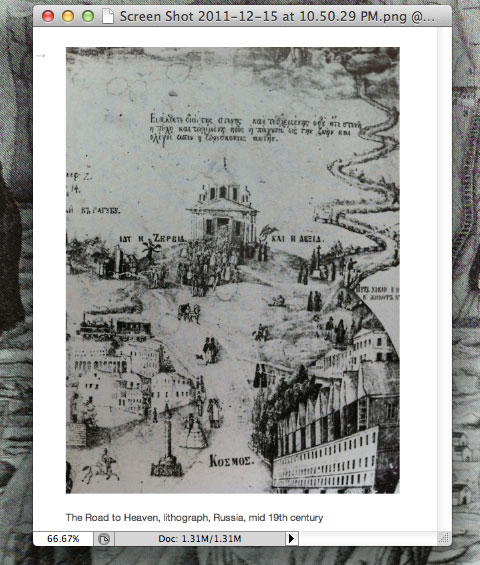
But after posting a Greek Orthodox lithograph 
of the ROAD TO HELL, 
the images that followed seemed to me making spooky sense:
from the same book I could not resist THE ROAD TO HEAVEN, as a delusional fantasy happy ending


it seemed there was still a chance of ending up in pink and friendly SPIRITUAL CITY
even little Jesus sat in an interesting chair during his TRIAL


but then, ominously, 
A PNEUMOSMIC ARENA appeared
FINANCIAL MARKETS TUMBLED
a strange wind
blew tumbleweeds into their CATCHER
an innocent white cube caught in the claws of BLACK METAL TECHNOLOGY (an appropriately dramatic ending)


PS: if you could just choose to stop tumbling, then it wouldn't be a tumble would it?

they PUSHED A BUILDING hopelessly
only to see it fold up on itself and 
FAN BACK DOWN TO THE NETHERWORLD

Tuesday, July 26, 2011

Athens Bookmark Timewarp

recently I stumbled upon this old book on Athens, and you know how old books are, everything looks sort of cool, like the Academy in 1900
the text was kind of complaining about Athens, like this image showing Omonia square (otherwise know as Junkie Central) "before it became a transportation hub". I guess that must be quite some time ago.
there was a map of Athens but it looked kind of boring and I couldnt tell how old it was, but the book definetly looked old.
as always, a nice plan of the acropolis as a palace proposal
then finally a date, Omonia Square in 1932,  before cars and junkies
 but then something weird. this picture looks really old too but the buildings not that old, and it says 1980, even if the photographic quality looks like from the 30s
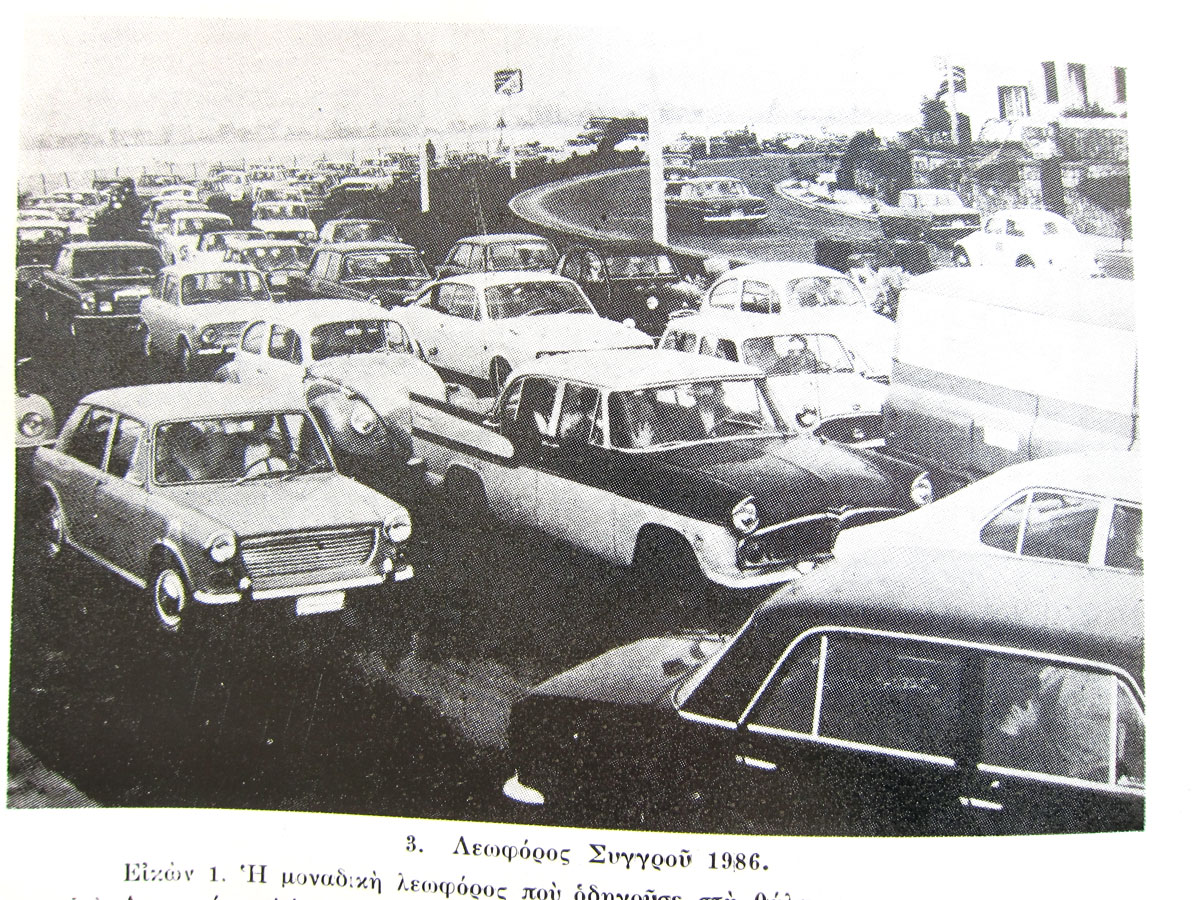
but even more confusingly, this picture says 1986, when there was definetly color photography right? and why do the cars look like something from Grease? was it a major 1950s revival in the 80s?
ok obviouly the book not only is made to look like a much older book than it is, its also getting all the dates wrong, like these two cuties here (Syngrou Avenue otherwise known as Tranny Boulevard, in 1905? with 70s' modernist knockoffs?)


even the scans are kind of warped
a building thats probably not even in Athens

of course the cover explains everything: Athens Past and Future, (timewarped)

Friday, May 20, 2011

OLGIATI XXL

 Just got sent the megabook on Valerio Olgiati, edited by Laurent Stadler and others
 the book is made by somehow gluing double pages against each other, resulting in an eminently openable series of perfect spreads
 quirky pet shop minimalism
 brilliant wedding cake extravaganzas
 a white building I almost identical to my "Mavala" project, only 5 years earlier
and a delirious stack of 3 ground floor buildings to make a 3 floor building

Sunday, March 27, 2011

Cognitive Architecture. From Biopolitics to Noopolitics. Architecture & Mind in the Age of Communication and Information


Just got my hands on a copy of the Cognitive Architecture mega-reader, edited by Deborah Hauptmann and Warren Neidich, 010 Publishers. 


With contributions from Andreas Angelidakis, Lisa Blackman, Ina Blom, Felicity Callard, Suparna Choudry, Jordan Crandall, Elie During, Keller Easterling, Lukas Ebensperger, Boris Groys, Janet Harbord, Deborah Hauptmann, Patrik Healy, Maurizio Lazzarato, Daniel Marguilles, Markus Miessen, Yann Moulier Boutang, Warren Neidich, John Protevi, Steven Quartz, Andreij Radman, Philippe Rahm, John Rajchman, Patricia Reed, Gabriel Rockhill, J.A. Scott Kelso, Terrence Sejnowski, Elizabeth Sikiaridi, Jan Slaby, Paolo Virno, Frans Vogellar, Sven-Olov Wallenstein, Bruce Wexler, Charles T. Wolfe.


My contribution is a text based on the talk I gave at TU Delft, titled "Can Architecture Save you from Facebook Fatigue?"


Chapters included are : 
OFFSCREEN, 
TRIPLESCREEN, 
SCREEN DISORDER, 
SCREEN BUILDINGS
and
CITIZENS OF THE SCREEN

Teleport Diner meets World of World of Warcraft

Sunday, December 26, 2010

Stacks of beach boulders in the snow

 Reading through issue zero of San Rocco magazine, with the White U house on the cover, 
a building I never understood until I knew it was a basically a mourning cave for Toyo Ito's sister
(at OMMU)
 then serendipitously bumping into an article on Hans Hollein's 3 travel agencies, (meanwhile I've been working on a tourism-related project)
 and an interesting reading of Artiga's Balneario in Jau
 moving through the stack to Peter Friendl's Secret Modernity, and finally the english language catalogue of Drifts and Derivations
and really learning more about the Vaiparaiso School of Architecture and stacks of beach boulders in the snow.

Saturday, November 06, 2010

Serafin og Plym

 A couple of days ago I rediscovered my favourite book as a kid, which I thought was long thrown away. It's the story of Serafin and Plym, 
two friends who were good at making things 
I guess the things they made were not so popular so they had to go from job to job

 
one day they decide to make a fantastic machine, that makes the most amazing fences ever


They celebrated the making of the machine, but when they tested it in the city, officials freak out, and Serafin and Plym got kicked out


So they decided to fence everybody in, then fence themselves in around hole in the ground


opening the sewer cover, they set off in an underground maze of caves, 
and they lived happily ever after,
 together.