Sunday, June 17, 2012

Vasby Labs / Workshops


How does one approach “development” and city growth in a landscape of countries going bankrupt? If it seems like the populations of the eurozone are hostage to a continuous exchange between banks and governments, where does that leave the citizen, and how should the architect or designer accept commisions?

Thats when urban sociologist and consultant Mia Lundstrom and writer, curator and urban thinker Jan Aman approached me with the idea of proposing development methods for a community just outside of Stockholm, Vasby.

Vasby is a typical Stockholm suburb, or rather, it is so typical as to be definitive of the type. Built during the Million program, it is the perfect mix of state funded apartment blocks and semi-detached homes.

[moving services around sometimes allows for better circulation]
The idea was to developing Vasby not only in financial or investment terms, but to develop it socially, to use the construction development as a tool for social restructuring, and to do this with the support and approval of the current citizens.


[cars and traffic are not always bad]
The project would be structured around a series of workshops, and I was initially asked to design a pavilion where the workshops would take place, and which could act as a “headquarters” for the project.
[urban planning exhibitions can happen in shopping malls too]
It would be a quick and fun project, but somehow I felt that a new structure was not what the project was calling for. Jan and Mia had made it clear that we would be working with the existing buildings, reconfiguring and re-programming, as much as proposing brand new development possibilities.

[sometimes you just need to position yourself where the citizen likes to be]
So instead of accepting the commission for a pavilion, I proposed to place the workshops in the local shopping mall, where civic activity was already taking place. Like this we would not need to officially invite the locals to participate, but rather we would position ourselves casually in their midst.
[a shopping mall corridor can make a great conference room, everybody is there]
Once in the mall, we saw that there were empty shops available, but decided to push the envelope a step further, and located some of the workshops right in the middle of the shopping mall corridor.
[modular boxes as workshop equipment]
(When in a shopping mall, I cannot help but think of Margaret Crawfords' excellent “The World in a Shopping Mall”, which perfectly captures the space of the contemporary consumer. 

[a shopping mall is a miniature city]
How a person entering a shopping mall usually slows down because they don't know exactly what they are looking for, but rather they are in browser mode, open to suggestions.
[in Vasby the mall exists right in the center of everything. or everything just grew around it]
Of course when Crawford wrote that text, she was talking about malls, now the internet is our mall and we are live in continuous browser mode, citizens of browserville.

So, the idea was that the Vasbians would stroll over to the workshop desks, where the participating architects and the bosses of development companies would be obliged to explain what they were planning for their community. 

[workshop modules can grow up to become exhibitions, rooms, desks, bookshelves, community centers]
And perhaps the Vasbians would have suggestions to make and even preferences to voice. 


[the mayor of Vasby presenting, while Vasbians shop for soap and stuff]
The citizens of Vasby would be participating in the process of designing their community, spontaneously, while doing their shopping or just hanging out. 

[plinths and boxes instad of pavilions]
And personally, I was fascinated by an "architectural proposal" that does not propose a structure but rather a social situation with potentially such far reaching consequences.


[part two: proposals, coming soon]

Saturday, May 12, 2012

Anatomy of Melancholy


Selections from the Anatomy of Melancholy by Robert Burton
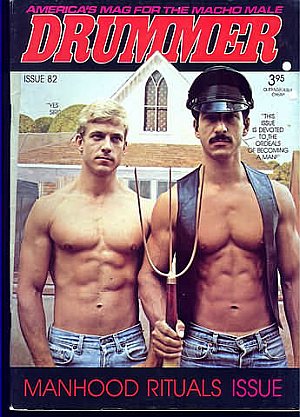
in-between photos from Drummer magazine
as put together by William E Jones.


Robert Burton was an Oxford scholar (1577-1640), who wrote the Anatomy of Melancholy as a manual for getting over chronic depression.


(published under the pseudonym Democritus Junior in 1621)


Drummer Magazine was "America's mag for the Macho male" published from 1975 until the late 1990s


Poverty and Want, causes of melancholy

 I write of melancholy, by being busy to avoid melancholy. There is no greater cause of melancholy than idleness, no better cure than business.
Melancholy in Disposition,
improperly so called,
Equivocations


[a heavy heart, hatchling in my head]

 Like all men, he was given bad times in which to live

 "Gay magazines originated in the early nineteen fifties from the physique magazines that already ... Well known Drummer Magazine first appeared in 1975."
 [152]———Arcades ambo
Et Cantare pares, et respondere parati.
Both young Arcadians, both alike inspir'd
To sing and answer as the song requir'd.

if I remember correctly, I got this at OMMU

Tuesday, May 01, 2012

Thoughts on an exhibition (Domesticated Mountain)


Recently I've been thinking about what it means for an architect to show in a gallery. Or what it means for a artist to present work that is perceived as architecture.

It became clear that the project and the exhibition should overlap. Of course the project was what was being exhibited, but the exhibition should be a project too, perhaps a project that informs the project itself. Almost inevitably, exhibitions are projects.


The main narrative of domesticated mountain takes place inside the video, the vehicle that carries the project, and it is also the object that occupies a spot between art and architecture, if only because it borrows it's form from film.
(but when an art installation is inhabitable, 

and actually a functional room in the space of the gallery, is it still art?)


All the other objects are more or less straightforward art or architecture: a large scale installation and short video fragments seem to be part of the art, and plans, section and model seem to be part of the architecture presented.


if, according to the video, we don't need buildings anymore, are the architectural plans and sections drawings of an un-proposed home? And could we say that they have crossed over to art, since they are not proposals?


Personally I was never interested in the what is what question, because the edges of the field have always been blurry, and writing a blogpost can be as architecture or as art as anything.
Plus, I do sometimes think about whether we indeed need buildings, and whether the only role for architects is to produce more objects, and if that is still a valid role. 

Couldn't it just be wrong to make any more buildings? Aren't we just serving the empire with products that in the end we despise? Doesn't every newly "developed" area just remind us of how scary is our postneoliberal reality? And could buildings play a role other than suspicious development tools for a post-capitalist landscape of perpetual crisis?


Domesticated Mountain
curated by Maria Cristina Didero
Gloria Maria Gallery, Milan

Wednesday, April 18, 2012

Domesticated Mountain


Domesticated Mountain proposes the suburban home as the traditional vehicle for an architectural manifesto.

Positioning the home in an expanded notion of suburbia, i.e. The internet, the suburban home is the accumulation of all the things we do online, and so it needs to be redefined from scratch.
(apparently online you can buy a photo of what your useless things being moved to your new house look like)

In order to redefine what makes our suburban home in the time of facebook and twitter and tumblr and pintrest, we go back to the most primitive state of a home.

The primitive state of such a suburban home is a transport van depositing boxes on the sidewalk.
These boxes contain the house.

(the house itself is a readymade, rented from an online agency of houses, picked from a list according to specifications. In this internet suburbia no more houses are designed, because enough readymades exist already)
(could this be a Villa Savoya made from transport packaging?)

the future of architecture
was often expressed
as a house

This initial primitive state of a house arriving at it's location as a set of transport boxes is a condition that continues throughout the life of this house, and perhaps becomes it's death.
The inhabitants constantly need more products to satisfy their ever expanding needs ("Do we need a raw almond puree maker darling? Yes we do").
But to be exact, they do not need the almond puree maker to make almond puree, they need it to satisfy their need of needing it. They just want to buy it, but not necessarily own it or use it.


So the inhabitants of the house go through evolutionary stages.

 First they bring all the stuff from their previous house, then they continuously purchase more stuff on the internet, but gradually become so saturated with browsing and buying that they forget what they bought. Boxes of bargains arrive at the house but nobody remembers buying them, because they have already discovered another site with better bargains, faster browsing, cheaper shipping.

(still from Domesticated Mountain)


This compulsive internet shopping is part of the inhabitants growing list of compulsive browsing behaviors. Every night they get lost in psychogeographic drifts down the jpeg avenues of tumblr, scrolling down cartesian city grids of thumbnails, making their situationist derives by caressing their ipad screens. 
silently they watched from across the street as their home morphed into a webpage of thumbnails. 
(they just couldn't' wait to start scrolling)


In these derives, they find everything: products to want, and buildings they like and archive material to reblog and bearded guys to make friends with. They find objects to order and have sent home and information to fill up their blogs and clothes to wear while browsing for more.


Soon they are saturated. They have seen all the images that exist on the internet, they have browsed all the bargain bins many times over, but they need more things to scroll through, sometimes not even looking at what they are looking at, just caressing and scrolling. 


(sometimes they shopped in their sleep, forgetting what they bought even before they completed their purchase)

They dont need to buy products anymore, they just add them to their dreamboxes, mark them as favorites, leave them rotting in the shopping cart in case they need something to want later on.

Slowly they realize that their home has become a mountain of things, stacked boxes of almond puree makers and organic ironing kits. And while this accumulating was going on, they got saturated with accumulating, with buying, with owning.

Suburbia is the timeless drift

of the Sleepy Situationist

looking for something to want


Now it was enough to just click on something and it had already partially been consumed. Consumed enough so that you could just scroll down to the next consumable image of product or information or person.
(at some point the citizens of internet suburbia decided to hold a protest against the sorry state of suburbia. But by the time they began, they had already forgotten what it was they were protesting)
Some accused Suburbia
of forgetting about public space
she did not forget
she just needed you to keep
buying


Has this evolutionary process of boxed products reached it's post-capitalist conclusion? 


Suburbia changed how they lived
changed how they shopped
drifting among products
browsing through people


Is it enough to just “consume” online without ever buying anything? Will the manifesto house, and its mountain of objects just evaporate into an ephemeral scroll up to the suburban sky?


Years later the geography of nowhere
became the internet of everywhere
the traditional shopping malls
replaced by the discount power centers
category killer hypermarkets
hooked on large infrastructural networks
feeding on the bloodstreams
of transportation and logistics 


No more products? no more buildings? no more images? no more real people? just a endless scroll of gaussian blurriness, a slow vertical drift into our internet suburbia.

 (photos and documentation fragments coming soon)

Domesticated Mountain
a project by Andreas Angelidakis
curated by Maria Cristina Didero
at GloriaMaria Gallery
opened 18th April 2012 
during the ultimate torrent of objects 
that is the Salone del Mobile in Milano


the exhibition consists of a short firm, video fragments, architectural drawings of an unproposed home, a 3D print that carried it's own shadow, and various furniture made from transport scraps. Oh and a site-specific domesticated mountain of stuff.


texts Andreas Angelidakis, Maria Cristina Didero
3D animation and drawings Sotiris Vasiliou
video editing and additional animation AA
3D printing Sculpteo using a zPrinter 650
special thanks: Angelo Plessas, Adelina von Furstenberg, Priscilla Tea, Fabrizio Meris, Alexandra Syriou, FedEx and the eternal genius of M. Ward


CLICK FOR PRESS MATERIAL


SELECTED PUBLICATIONS


review on ARTFORUM by Marco Tagliafierro


DOMUS video interview with Simona Bordona


review on Arttribune by Riccardo Conti

The Suburban Home as Vehicle for an Architectural Manifesto by Ethel Baraona Pohl / dpr-barcelona

Short interview by Elena Bordignion / ATPdiary.com 


WIRED / Brude Sterling 

"A BOX WILL BURY US" by Daniele Perra, GQ Italia

review by ivanmaria vele

Marriucia Casadio _Vogue Italia

Rhizome New York